


From The Guardian (UK)
The Paris riots over the arrest of a veiled Muslim woman reveal the ongoing tension between the police and minority populations.
Valérie Amiraux and Marwan Mohammed
guardian.co.uk,
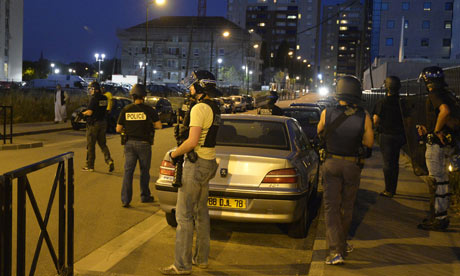
The trigger for the riots in the Parisian suburb of Trappes last weekendwas a relatively ordinary one: the local police stopped a young woman for wearing the full veil in public. Ordinary, that is, since the inception, in April 2011, of Law 2010-1192 of 11 October 2010 prohibiting the concealment of the face in public space, according to which the wearing of this type of garment can lead to a fine of €150 (£129) and a “community rehabilitation programme” in the form of mandatory citizenship classes. Over the course of two years, the police have issued 705 citations.
In many ways, the arrest in Trappes was routine from the point of view of both the police and the young woman concerned. But it took a bad turn: the young woman and her husband were taken to the station, the Trappes commissioner refused to register the complaint made by the young woman’s mother, who was witness to the arrest, and civil unrest erupted over the course of that Friday, followed by numerous further arrests.
The context within which this episode took place is slightly more difficult to untangle. There is an easy tendency, sustained by the media, to accentuate the extreme social precariousness in the French suburbs, the failure of national integration, the continuing problem of the suburbs, regardless of the particular political persuasion of the government in charge. Every one of these colours the context. But there is a new element in play during these incidents in Trappes: Islamophobia.
It shows up in multiple forms: attacks on mosques, desecration of religious sites, the ban on the headscarf in public schools, making it impossible for certain veiled women to access public services, to accompany their children on school outings, the rampant insults, harassment, humiliation, physical and verbal aggression they are subject to, racial and ethnic profiling and discrimination, sometimes culminating in physical attacks, such as the recent one on a veiled woman in Argenteuil, who lost her baby as a result. But the principal characteristic of Islamophobia is that it remains, at least in France, very rarely denounced. It is consistently perceived as an exaggeration, the result of victimised posturing invented by troublemaking Muslims, who are incapable of integrating and bending to the requirements of French citizenship.
In Trappes, Islamophobia has crossed another line of French political history, that of the relationship between the police and the populace, particularly the minority population. The history of the French police is inseparable from the progressive construction of the state. The police force, nationalised and centralised, emerged as a front against regional powers, and subsequently grew its power and influence against the working and anti-colonialist classes over the last century.