


From CNN Money
By Sarah Stankorb @CNNMoney February 6, 2014: 6:58 AM ET
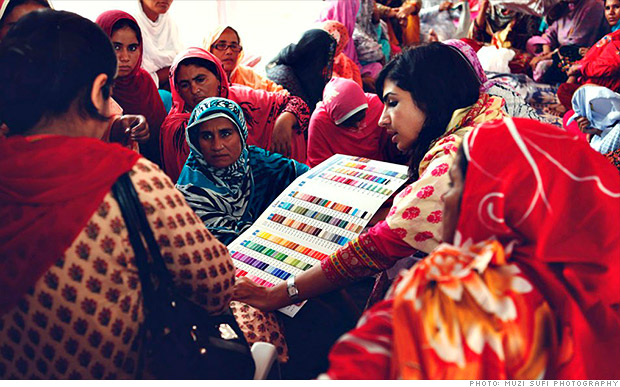
Popinjay is a high-end handbag company that attracts customers with lush leather and hand-embroidered silk. The designs draw inspiration from Mughal screens, Turkish tiles and Jerusalem’s Dome of the Rock. But the Pakistani women who embroider them were once deeply impoverished.
The company’s mission — producing fair-wage jobs for these women — smacks of social consciousness, but wasn’t enough to compete in the $9 billion handbag market.
About a year ago, when Popinjay was operating as the nonprofit BLISS, it teetered on the brink of collapse.
MIT-educated founder Saba Gul had left a six-figure engineering job to launch the nonprofit and create an alternative for Pakistani girls often forced to leave school young and work for a pittance. For Gul, who is Pakistani, it was too sharp a contrast to her own life.
In March 2011, with about $20,000 in personal savings and $9,000 in Indiegogo funds, Gul launched BLISS, which offered a living wage to 40 uneducated Punjabi women who otherwise survived on about $2 a day.
It was personally fulfilling work for Gul, but by the third quarter of 2012, progress slowed. The venture was unable to launch a new collection, and sales channels were limited. By the fourth quarter, sales stagnated.
“I think we were two weeks, maybe three weeks, from running out of money,” says Gul.
Since BLISS worked directly with the underprivileged, a nonprofit formulation had seemed natural to Gul. But it came with unforeseen complications.
“I heavily underestimated the frustrations of raising nonprofit money,” says Gul. She had a fast-paced, start-up mentality but faced funding cycles that were a year or two long.